
Ueno vs Asakusa: Rail Access or Old-Town Atmosphere
Asakusa or Ueno for your Tokyo hotel? Ueno wins on Narita access (Skyliner 36 min), budget hotels, and a 7-min hop to Tokyo Station; Asakusa wins on old-town atmosphere and Senso-ji. Side-by-side compare with hotel picks for first-time visitors.
A local map for calmer East Tokyo hotel areas
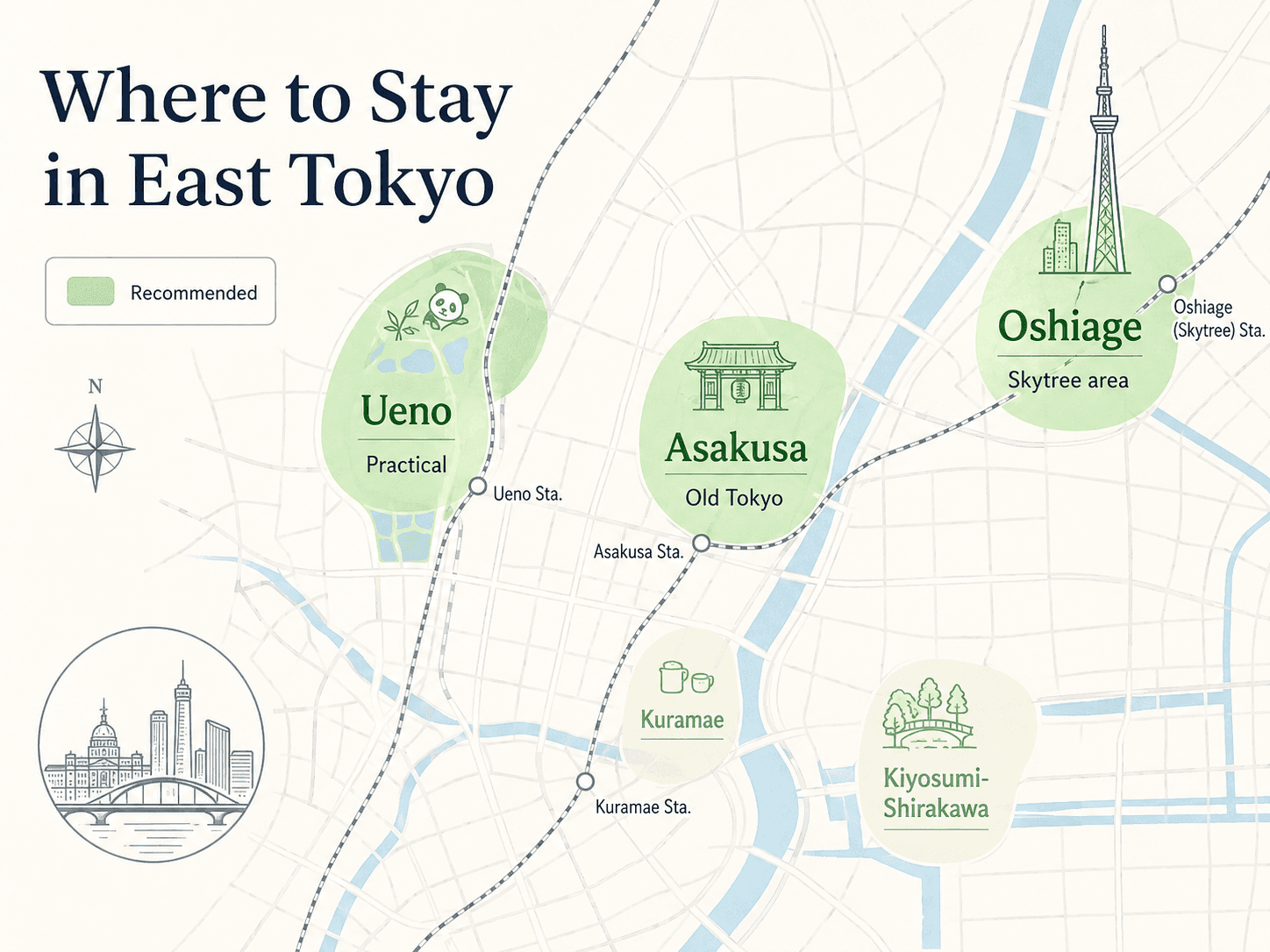
Use this as a simple overview when considering a calmer East Tokyo base.
This is a simplified local guide map, not a precise navigation map. Use it to understand the general hotel-area logic, then check exact locations on Google Maps or your booking site.
Stay in Ueno
Ueno is usually the more practical first-time base thanks to Narita access and JR links. Asakusa is better for atmosphere and temple walks.
Area breakdown
Compare the practical fit of each area before choosing where to search.
Asakusa
Traditional Tokyo — temples, Skytree, calm evenings
Pros
- Senso-ji and Nakamise nearby
- Tokyo Skytree walking distance
- Old-town atmosphere
Cons
- Longer transfer to Tokyo Station
- Fewer late-night options
- Rail days need more planning
Ueno
Calm, cultural, budget-friendly
Pros
- More budget hotel options in central Tokyo
- Fast Skyliner access from Narita
- Museums, park, and Ameyoko market nearby
Cons
- Quieter nightlife
- Fewer late-night dining options
- Some streets feel dated
Side-by-side comparison
| Asakusa | Ueno | |
|---|---|---|
| Narita Airport | Access Express 55 min | Skyliner 36 min |
| Tokyo Station (Shinkansen) | Metro + JR 25 min | JR 7 min |
| Atmosphere | ★★★★★ (old-town temples) | ★★★☆☆ (park and markets) |
| Food & dining | ★★★☆☆ (traditional, tempura) | ★★★★☆ (Ameyoko, izakaya) |
| Museums | ★★☆☆☆ | ★★★★★ (National Museum, Ueno Zoo) |
| Budget hotels | ★★★☆☆ | ★★★★★ |
| Luggage ease | ★★★☆☆ | ★★★★☆ |
| Hotel cost feel | Good value, fewer options | More budget options |
Scored side by side
Our own scores for the things that decide a hotel base, from 0 to 100. Calm is scored so that a higher number means a quieter street; the rest read as you would expect.
Airport access
Shinkansen access
Luggage ease
Station simplicity
Sightseeing access
Hotel choice
Local character
Calm
Getting between Ueno and Asakusa
The two stations are three stops apart on one Metro line, which is why you can treat them as a single area when you choose a hotel. Asakusa Station has no JR platforms, so this short hop is the one leg here a Japan Rail Pass will not cover.
| Ginza Line (G)Best | Asakusa G19 → Tawaramachi → Inaricho → Ueno G16. Three stops, direct, no transfer. Trains run every few minutes all day. | 5 min |
|---|---|---|
| On foot | Straight down Kappabashi-dori (Kitchen Town, where restaurants buy their knives and plastic food samples) or along the Sumida River. Pleasant without luggage. | 20–25 min |
| JR | Not possible. Ueno is a major JR station, but Asakusa is served only by Tokyo Metro, Toei and Tobu — so a JR Pass is no help on this leg. | — |
Asakusa is the Ginza Line's terminus, so trains toward Ueno start there: same platform every time, and you normally board an empty train and get a seat — worth knowing on a day you are carrying bags between hotels.
Ueno and Asakusa are very close, so you can stay in the practical one and visit the atmospheric one easily.
More hotel search options
Check more hotels in this area
Use these broad area searches after comparing the station-area trade-offs. They are not individual hotel rankings.
Asakusa
Broad area searches on Klook — useful once the station-area trade-offs above have settled it.
Ueno
Broad area searches on Klook — useful once the station-area trade-offs above have settled it.
Related stay planning
Use these only after you have chosen the hotel area.
All Tokyo area comparisons
Ueno, Asakusa, Shinjuku and Tokyo Station, scored side by side.
See all areasNarita → Asakusa
Access Express and other routes from Narita.
See routesNarita → Ueno
Skyliner and other routes from Narita.
See routesPartner links shown where they match the planning step.
FAQ
- Is Asakusa or Ueno better for first-time Tokyo?
- Ueno is more practical for Narita and JR access. Asakusa is better for old-town atmosphere.
- Which is closer to Narita Airport?
- Ueno is faster because the Skyliner runs directly from Narita to Ueno.
- Is Asakusa good for families?
- Yes. Senso-ji, Nakamise, and Skytree are family-friendly, and evenings are calmer than Shinjuku.
- Can I walk from Ueno to Asakusa?
- Yes. It is about a 20-minute walk, or one short ride on the Ginza Line.
- Is Asakusa or Ueno cheaper for hotels?
- Ueno generally has more budget hotels and hostels, especially around Ueno Station and Okachimachi, so it is the easier area to find a low-priced room. Asakusa has good value too but fewer rooms overall, so prices can rise on busy dates. Check live prices for both before deciding.
- Ueno or Asakusa for an easy first night with luggage?
- Ueno is easier: the Keisei Skyliner runs direct from Narita (36 min) straight to Ueno, so you arrive with minimal transfers. From Asakusa the Access Express takes about 55 minutes. If your first night is right after a long flight, Ueno keeps luggage handling simplest.
- Which has more to do at night, Asakusa or Ueno?
- Ueno has more late dining and izakaya, especially around Ameyoko, while Asakusa is quieter after the temples close in the evening. For nightlife you would still go to Shinjuku or Shibuya, but between these two, Ueno stays livelier later.
- Are there onsen or ryokan hotels in Ueno or Asakusa?
- Ryokan-style rooms are easier to find in Asakusa, where the old-town district still has small traditional inns near Senso-ji. Genuine onsen — a natural hot spring — is rare anywhere in central Tokyo. What you will find in both areas is hotels with a large communal bath (daiyokujo), which looks and feels like an onsen but is heated tap water. If a real hot spring matters to you, that is a day trip to Hakone or Kusatsu rather than a hotel choice here, so search for a public bath rather than an onsen when you filter.
- Where are the 4-star hotels in the Ueno–Asakusa area?
- Ueno carries more of the upper-mid range, clustered within a few minutes of Ueno Station, because it is a business and transport hub. Asakusa has fewer four-star rooms overall, but its better properties tend to be riverside or Skytree-facing, so you trade choice for a view. Neither area is where Tokyo's luxury hotels sit — that is Marunouchi, Ginza and Roppongi — so check live prices before assuming a star rating means the same thing across the two.
Still not sure where to stay?
Answer 2 questions — get your Tokyo base in 20 seconds.
🚄 Shinkansen departure?
🧳 Luggage?
Suggested next steps