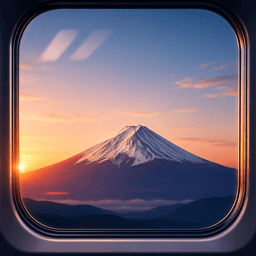
Which Side of the Shinkansen for Mt. Fuji? Right Side, Seat E
A practical guide to the best Shinkansen seats, sections, and timing for Mt. Fuji views.
Written by a Japanese local, for visitors who don't want to miss the Mt. Fuji × Shinkansen view.
Quick Answer
Book Seat E in standard cars. Use Seat D in Green Car.
- Tokyo → Kyoto/Osaka: right side, Seat E.
- Kyoto/Osaka → Tokyo: left side, Seat E.
- Green Car: usually Seat D for the Mt. Fuji window.
- Best timing: be ready around Shin-Fuji.
Free seat checker
Which way are you travelling?
Book Seat E after checking your direction
Reserve your Shinkansen ticket in English and select the Fuji-side seat when available.
Book Shinkansen ticket on KlookFuji window forecast
Will you see Mt. Fuji from your train?
Pick your departure and we'll work out the minute your train reaches the Fuji stretch — then show the sky forecast for that exact hour. Updated daily, so check again closer to the day.
Taking an early Shinkansen from Tokyo?
Seat E solves the Fuji view. Your hotel base solves luggage stress if you are leaving early with bags.
Mt. Fuji view basics on the Tokaido Shinkansen
Quick Answer: For Tokyo to Kyoto or Osaka, sit on the right side of the Shinkansen in Seat E. For Kyoto or Osaka back to Tokyo, sit on the left side, also Seat E. Mt. Fuji appears around Shin-Fuji station for about 30 to 60 seconds.
Many visitors to Japan want to see Mt. Fuji from the Shinkansen, but it's easy to miss if you don't know which side or section to sit in. This guide explains where and when Mt. Fuji is visible from the Tokaido Shinkansen between Tokyo and Osaka/Kyoto, and how to make it easier by using our free Shinkansen Mt. Fuji Seat Checker tool.
You won't see Mt. Fuji for the whole ride – it appears only for a short stretch of the journey, and it can be completely hidden by clouds on some days.
TL;DR — which side and which seat for Mt. Fuji
- Which side? Tokyo → Osaka/Kyoto = right side. Osaka/Kyoto → Tokyo = left side.
- Which seat? In most standard 3+2 cars, Seat E is the Mt. Fuji window seat.
- Where on the route? Around Shin-Fuji station, between Shin-Yokohama and Shizuoka.
- When? Clear days, usually late morning to early afternoon (season-dependent).
- Don't want to memorize this? Use the free Shinkansen Mt. Fuji Seat Checker on fujiseat.com before you book.
Which side of the Shinkansen is Mt. Fuji on?
Quick Answer: Going from Tokyo to Kyoto or Osaka, Mt. Fuji is on the right side of the Shinkansen — specifically Seat E in standard cars. Going from Kyoto or Osaka back to Tokyo, it is on the left side — also Seat E. The view appears around Shin-Fuji station and lasts about 30 to 60 seconds.
Tokyo → Kyoto / Osaka: right side
- Tokyo → Osaka / Kyoto: Mt. Fuji is on the right side of the train (window seat E in most standard cars).
Kyoto / Osaka → Tokyo: left side
- Osaka / Kyoto → Tokyo: Mt. Fuji is on the left side of the train (again, window seat E in most standard cars).
What side for Tokyo to Osaka, Tokyo to Kyoto, and back
In most standard (non–Green Car) 3+2 seat cars, Seat E is the window seat on the Mt. Fuji side. Green Cars may have a different layout, but the same left/right rule still applies. Some older guides still mention different seat letters, but on most modern 3+2 standard cars, Seat E is the Mt. Fuji window seat.
Shinkansen seat letters explained (A, B, C, D, E)
Quick Answer: Standard Tokaido Shinkansen cars have a 3+2 seat layout with letters A, B, C on one side and D, E on the other. Seat E is the Mt. Fuji window seat in standard cars. Green Cars use a 2+2 layout where Seat D is the Mt. Fuji window. Seat A is always the opposite sea side.
Seat E is the Mt. Fuji window seat in standard 3+2 cars
- Cars 4–7 often give the clearest unobstructed views
- Seat E = Mt. Fuji window seat in all standard cars
Seat D is the Mt. Fuji window in Green Cars (2+2 layout)
- Mt. Fuji window seat = Seat D
Seat A is the opposite side (sea side)
Seat A is useful if you want the sea-side window, but it is not the Mt. Fuji-side window on the Tokaido Shinkansen.
Why Seat E matters more than right side alone
When booking online, you usually choose a seat letter rather than only a side of the train. Seat E is the practical instruction most travelers need.
When to see Mt. Fuji from the Shinkansen
Quick Answer: Late morning to early afternoon usually gives the clearest view of Mt. Fuji on a typical day. Winter (December–February) is the best season for a snow-capped silhouette and clear skies. Mt. Fuji is generally not visible at night because the mountain is unlit.
Best time of day — late morning to early afternoon
- Before 10am: Often clearest before haze builds
- Late morning to early afternoon: Good on clear days
- Late afternoon: Sun glare possible on the Mt. Fuji side
Best season — winter for snow-cap, autumn for clear skies
Can you see Mt. Fuji at night from the Shinkansen?
Usually no. Mt. Fuji is not lit at night, so even from the correct side it is normally too dark to see.
Live visibility check before you board
Before booking or boarding, check today's live visibility with the free seat checker.
Where on the route does Mt. Fuji appear?
Quick Answer: Mt. Fuji becomes visible from the Tokaido Shinkansen between Shin-Yokohama and Shizuoka stations, with the clearest view around Shin-Fuji station. Total visibility window is about 30 to 60 seconds at full Shinkansen speed, so have your camera ready before reaching Shin-Fuji.
Around Shin-Fuji station — the prime viewing zone
You won't see Mt. Fuji for the whole ride – it appears only for a short stretch of the journey. Mt. Fuji is usually visible on clear days between Shin-Yokohama and Shizuoka, especially around Shin-Fuji station.
How long is Mt. Fuji visible from the train? (about 30-60 seconds)
Mt. Fuji can appear and disappear quickly, especially around Shin-Fuji station.
Tokaido Shinkansen route map — Shin-Yokohama to Shizuoka
- Route: Tokaido Shinkansen between Tokyo, Nagoya and Osaka/Kyoto (Nozomi / Hikari / Kodama).
- Weather: On cloudy or hazy days, Mt. Fuji may be hard to see even from the correct side and seat.
Nozomi vs Hikari vs Kodama — which Shinkansen for Mt. Fuji?
Quick Answer: All three Tokaido Shinkansen services pass Mt. Fuji, and the seat to pick (Seat E) is the same regardless. Hikari and Kodama stop at Shin-Fuji station, which can give a slightly longer viewing window. Nozomi is fastest but does not stop at Shin-Fuji.
Nozomi: fastest, but no Shin-Fuji stop
Nozomi trains still pass the Fuji viewing zone, but they do not stop at Shin-Fuji.
Hikari and Kodama: stop at Shin-Fuji, slightly better viewing
Note: The Nozomi (fastest) may require an additional NOZOMI MIZUHO Ticket (approx. ¥4,960 Tokyo→Kyoto/Osaka) on top of your JR Pass. Without it, use Hikari or Kodama — these stop near Shin-Fuji, which is actually better for Mt. Fuji views anyway.
Does the train type change which seat to pick? (no — Seat E either way)
The left/right rule and Seat E recommendation do not change between Nozomi, Hikari, and Kodama standard cars.
JR Pass vs single ticket — which is cheaper for Tokyo-Kyoto?
Quick Answer: For a simple Tokyo–Kyoto round trip, single tickets are cheaper (about ¥29,000 round trip vs ¥50,000 for a 7-day JR Pass). The Pass starts paying off only when you add Hiroshima, do 2+ long-distance rides, or take multiple Shinkansen segments in one week.
Single reserved seat prices (Tokyo ↔ Osaka/Kyoto):
- Tokyo → Shin-Osaka: approx. ¥14,720
- Tokyo → Kyoto: approx. ¥13,850
- Round trip Tokyo ↔ Osaka: approx. ¥29,440
JR Pass prices:
- 7-day: ¥50,000
- 14-day: ¥80,000
- 21-day: ¥100,000
JR Pass is usually worth comparing only if you take multiple long Shinkansen rides (e.g. Tokyo → Kyoto → Hiroshima → Tokyo). For a simple Tokyo ↔ Osaka round trip, single tickets are often cheaper.
Note: The Nozomi (fastest) may require an additional NOZOMI MIZUHO Ticket (approx. ¥4,960 Tokyo→Kyoto/Osaka) on top of your JR Pass. Without it, use Hikari or Kodama — these stop near Shin-Fuji, which is actually better for Mt. Fuji views anyway.
For a route-level decision before buying, use the JR Pass vs single ticket guide.
Staying in one region?
A whole-Japan pass rarely pays off for a single region. These cover the same ground for less.
If your route includes Tokyo → Kyoto/Osaka → Hiroshima, several long JR rides, or a return to Tokyo, check JR Pass options before booking single tickets.
Check JR Pass options on KlookTo see how this fits into a trip plan, see how this fits into a 7-day route.
How to book Seat E — step by step
Quick Answer: At a JR ticket office, show 「E席をお願いします」 (Please give me Seat E). On Klook, choose your route then select column E from the seat map. With a JR Pass, walk into any JR Reservation Counter — seat reservations are free.
At a JR ticket office (Japanese phrase included)
- At JR ticket office: show 「E席をお願いします」
Booking via Klook (English UI)
Choose the Tokaido Shinkansen route, then select column E on the seat map when the option is available.
Reserving with a JR Pass
With a JR Pass, reserve your seat at a JR Reservation Counter before boarding. For an early Shinkansen day, it can help to stay near Tokyo Station for an early Shinkansen day.
Staying in Tokyo around your Shinkansen? Pick your hotel area first.
The right base near your route saves time with luggage and early trains.
Select your route first, then choose Seat E when seat selection is available.
Decision gateway
After checking Seat E, choose your next step
Common mistakes when trying to see Mt. Fuji from the Shinkansen
- Booking the wrong side: Forgetting that Tokyo → Osaka/Kyoto is right side, and the opposite for the return.
- Expecting a guaranteed view: Even with the correct seat, clouds or haze can fully cover the mountain.
- Looking too late: If you start looking only near Shizuoka, you might miss the best view around Shin-Fuji.
The same planning logic applies when you land: do not make the same mistake on arrival day by choosing the wrong airport transfer for your luggage and arrival time.
Local train etiquette note: priority seats (優先席) are different from Shinkansen reserved seats. If you are unsure, avoid them or offer the seat immediately. Read basic Japanese train signs and etiquette.
Pre-departure checklist
Keep the booking steps in order: route first, rail second, arrival basics after.
Frequently Asked Questions
Q: Which side of the Shinkansen is Mt. Fuji on from Tokyo to Kyoto?
A: From Tokyo to Kyoto or Osaka, Mt. Fuji is on the right side of the Shinkansen. In standard cars, choose Seat E for the Fuji-side window.
Q: Which seat letter should I book to see Mt. Fuji?
A: Book Seat E in standard 3+2 cars. In Green Cars with a 2+2 layout, the Mt. Fuji-side window is usually Seat D.
Q: Can I see Mt. Fuji from the Nozomi Shinkansen?
A: Yes. Nozomi does not stop at Shin-Fuji, but it still passes Mt. Fuji. From Tokyo to Kyoto or Osaka, choose the right side, Seat E.
Q: When is the best time to see Mt. Fuji from the Shinkansen?
A: Late morning to early afternoon on a clear day often works well. In summer, morning can be better before heat haze builds up.
Q: How long can I see Mt. Fuji from the train?
A: The main view usually lasts under a minute around Shin-Fuji. Have your camera ready before that part of the route.
Q: Is the JR Pass worth it for Tokyo to Kyoto or Osaka?
A: For a simple Tokyo-Kyoto or Tokyo-Osaka trip, single tickets usually make more sense. Check JR Pass options if you add Hiroshima or several long-distance JR rides.
Q: Can I reserve a Fuji-side seat with oversized luggage?
A: Yes, but reserve early if you also need oversized luggage space. Fuji-side window seats and luggage seats can both sell out.
Q: What should I do if Seat E is not available?
A: Try another train time, or choose another right-side seat from Tokyo to Kyoto or Osaka if the seat map allows it.
Q: Should I stay near Tokyo Station before an early Shinkansen?
A: Tokyo Station can reduce luggage stress for early trains, but Shinjuku, Ueno, and Asakusa may fit different travel styles.
Q: Can I see Mt. Fuji from a non-reserved car?
A: Yes, but risky — you may end up in an aisle seat with no view. Reserve Seat E in advance.
Q: What if it's cloudy?
A: Mt. Fuji is often hidden, especially in summer. Check our live visibility indicator at the top of the page.
Q: Can I see Mt. Fuji on the return trip (Osaka/Kyoto → Tokyo)?
A: Yes — Mt. Fuji is on the LEFT side, which is again Seat E. Use our checker and select the opposite direction.
Q: Can I bring large luggage on the Shinkansen?
A: Bags with total dimensions over 160cm and up to 250cm require a seat reservation with an oversized baggage area (予約が必要). Reserve this when booking your Shinkansen seat. Bags over 250cm are not permitted.
Q: Is there WiFi on the Shinkansen?
A: Onboard WiFi exists but can be unreliable. A Japan eSIM is recommended for consistent connectivity throughout your trip.
Q: What is the best way to book as a foreigner?
A: Klook — fully in English, instant mobile voucher, and you can select Seat E on the seat map.
Make it easy with the Shinkansen Mt. Fuji Seat Checker
If you don't want to remember all the details, you can use our free Shinkansen Mt. Fuji Seat Checker. Just choose your direction and it tells you which seat to book for the best chance of seeing Mt. Fuji.
The tool is designed to work well on mobile, so you can quickly check it while booking tickets or travelling in Japan.
Seat guides by topic
Want to see Mt. Fuji up close?
The train window is a few minutes. These are the usual ways to spend a day at the mountain.
Still not sure where to stay?
Answer 2 questions — get your Tokyo base in 20 seconds.
🚄 Shinkansen departure?
🧳 Luggage?
Continue planning