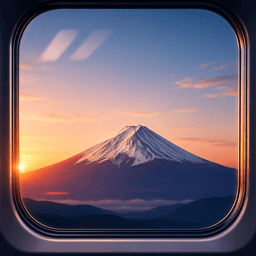
Seat class decision
Shinkansen Reserved vs Non-Reserved Seats: Which Should You Book?
Reserved seats cost only a few hundred yen more and guarantee your seat — and the Mt. Fuji window. Non-reserved cars are first-come, first-served. When each makes sense, and when non-reserved is a bad idea.
Quick answer
- Default: reserve. A few hundred yen buys a guaranteed seat — and lets you pick Seat E.
- Mt. Fuji view: only a reservation guarantees the E-seat window.
- Big suitcase: reserved is effectively required — oversized-baggage seats are reserved-only.
- Non-reserved works: short hops, flexible solo travel, off-peak hours.
What you actually get for the extra fee
A reserved ticket names your car and seat, so you can board a minute before departure and walk straight to it. That certainty is what you are buying: a chosen seat (including the Fuji-side Seat E), guaranteed space for your group to sit together, and no queueing on the platform.
Non-reserved cars are first-come, first-served. Outside rush hours from a starting station like Tokyo, you will usually find a seat — but not necessarily a window, and rarely three seats together. From mid-route stations at busy times, standing is a real possibility.
The Mt. Fuji reason to reserve
The Fuji-side window is a specific seat — Seat E in Ordinary Cars. In a non-reserved car you compete for it with everyone who boarded before you. If the view is one of the reasons you booked a daytime train, spend the few hundred yen and lock the seat when you book.
When non-reserved is the right call
Non-reserved shines for flexibility on short segments: Tokyo to Odawara or Atami, a spontaneous Kodama hop, or when you don’t want to commit to a departure time. Trains run so frequently that missing one costs minutes, not hours. Keep it for light-luggage, off-peak, solo situations — and note that during peak holiday weeks some trains run fully reserved.
Book with a reserved Seat E
Pick the seat from the seat map when booking — column E for the Mt. Fuji side.
FAQ
- How much more does a reserved Shinkansen seat cost?
- Usually a few hundred yen (roughly ¥500–¥900 depending on season) on top of the base fare — a small share of a ticket that costs over ¥13,000 Tokyo to Kyoto. Prices vary, so confirm when booking.
- Can I see Mt. Fuji from a non-reserved car?
- Only if you manage to grab an E-seat window, which is not guaranteed — at busy times you may stand or sit on the aisle. If the Mt. Fuji view matters to you, reserve Seat E in advance.
- Which cars are non-reserved on the Tokaido Shinkansen?
- Typically the first cars of the train (cars 1–3 on most Tokaido services). During the busiest holiday periods some trains run fully reserved, so check before relying on non-reserved cars.
- When is non-reserved actually the better choice?
- Short hops (like Tokyo to Odawara or Atami), fully flexible departure times outside rush hours, and solo travel with light luggage. You can just walk up and take the next train.
Related pages
Étapes suivantes suggérées